Quick answer: Saltwater corrosion attacks a boat’s metal, chrome, and stainless steel through repeated wet-dry cycling, especially at cleats, transom bolts, rails, and fittings. The fix is consistent fresh-water rinsing after every outing, monthly inspection of high-risk zones, and a professional metal polishing and sealant treatment a few times a year. Blue Diamond Detailing offers marine metal polishing across South Florida and the Florida Keys.
Why Saltwater Is So Hard on Boat Metal
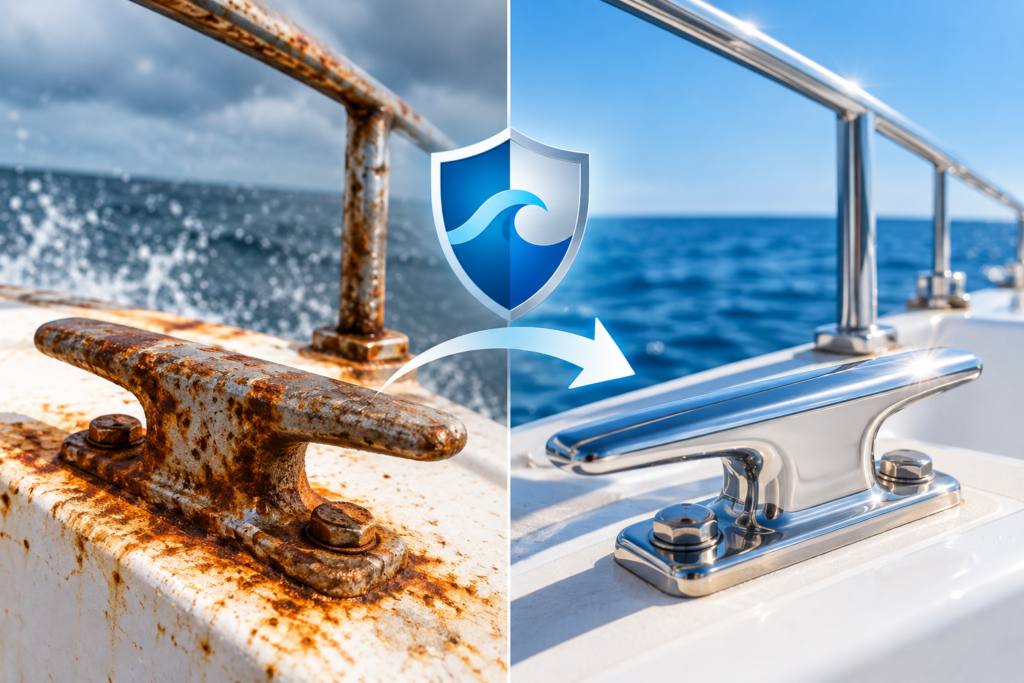
If you keep a boat in South Florida waters, you already know the trade-off: incredible access to the water comes with relentless exposure to salt air, UV, and humidity that will eat away at unprotected metal faster than almost anywhere else in the country. Chrome cleats, stainless steel railings, transom hardware, and trailer frames are constantly cycling between wet and dry, and that cycle is exactly what accelerates rust and pitting. Left unchecked, it doesn’t just look bad, it weakens hardware that your rigging, docking, and safety equipment depend on.
The High-Risk Zones Every Boat Owner Should Check
Corrosion rarely shows up evenly across a boat. It concentrates in specific areas where saltwater collects and dries repeatedly:
- Bilge floors, where water pools and salt residue builds up unseen
- Transom bolts and motor brackets, under constant stress and spray
- Trailer frames, exposed to salt on every launch and haul-out
- Fuel tank straps and dock cleats, hardware that’s easy to overlook until it fails
- Bunk brackets, hidden but heavily exposed on a trailered boat
A quick visual check of these zones after every few outings catches rust bloom early, before it becomes a bigger repair.
A Practical Saltwater Corrosion Prevention Schedule
After every outing
Rinse the entire boat, hull, deck, and metal fittings, with fresh water. This single habit does more to slow corrosion than almost anything else on this list.
Monthly
Inspect bilges and hidden metal surfaces for early rust bloom. Catching a small spot now prevents a much bigger job later.
Every haul-out
Power-wash the trailer frame and touch up any bare metal spots before they have a chance to spread.
Annually
Check transom bolts, motor brackets, and other structural hardware for pitting or looseness caused by corrosion.
Every 3 to 5 years
Strip and recoat high-exposure surfaces with a marine-grade protectant, restoring the barrier between metal and salt air before failure sets in.
Products That Help: Rust Converters, Primers, and Protectants
For metal that already shows surface rust, a rust converter changes the chemistry of the corrosion itself rather than just covering it up. Widely used options in the marine and automotive world include Ospho, a phosphoric acid–based treatment that’s been converting rust since 1947, and Corroseal, a water-based converter and primer in one step. For ongoing exterior protection between details, marine-specific cleaners and protectants from brands like Star Brite help maintain the sealant layer between professional treatments.
Important: converters and protectants only slow or reverse surface-level corrosion. Metal that has already perforated needs to be cut out, welded, or replaced, no product fixes structural damage after the fact.
Why Professional Metal Polishing Beats DIY in Salt Air Climates
DIY polish gets chrome shiny for a week. What actually protects stainless and chrome long-term in a saltwater environment is proper surface prep, the right polishing compound for the metal type, and a sealant applied correctly to block moisture from re-entering the microscopic pores of the metal. That’s the gap professional metal polishing is built to close, restoring oxidized and pitted metal and then sealing it against the next round of salt exposure.
It pairs naturally with the rest of a full marine detail. If your gelcoat took a hit from this summer’s sun and salt too, our recent guide on fixing oxidized gelcoat fast covers the hull side of the same seasonal maintenance push.
Book a Marine Detail Before Corrosion Gets Ahead of You
Blue Diamond Detailing services boats, yachts, and marine vessels from Miami-Dade and Broward up through the Florida Keys, with mobile detailing available at your marina or dock. Schedule a boat detailing appointment or contact our team to build a metal protection plan around how often you’re on the water.
Frequently Asked Questions
How often should I rinse my boat to prevent saltwater corrosion?
After every single outing, if possible. Fresh water rinsing after saltwater exposure is the single most effective habit for slowing corrosion on metal fittings and hardware.
Can rust converters fix a hole in metal caused by corrosion?
No. Rust converters and primers stop surface-level corrosion from spreading, but perforated or structurally weakened metal needs to be repaired or replaced by a professional.
How often does a boat need professional metal polishing in South Florida?
Most boats kept in South Florida’s saltwater and sun benefit from professional polishing and sealing a few times a year, with more frequent maintenance for vessels docked full-time versus trailered boats.
Does saltwater corrosion affect stainless steel, or just chrome?
Both. Stainless steel is more corrosion-resistant than untreated metal but is not immune, especially in crevices, welds, and areas with reduced oxygen flow, where a form of pitting corrosion can still take hold.